Strengthening the operations that keep people fed, housed, and healthy.
Assistant Professor of Operations Management at Rutgers School of Business Camden in New Jersey
About me
Mark Brennan is a professor, logistician, and data scientist at Rutgers University in Camden. His work focuses on retail and frontline services, with the aim of making basic necessities—food, housing, and healthcare—more available to people in need. Mark is committed to broadening operations management’s empirical evidence base in these areas, building bridges between supply chain ideas and urban planning problems, and sharing this thinking in public forums, including The Hill and New Jersey media outlets like the Star-Ledger. Mark’s academic work on health and urban operations has appeared in top journals across the operations and policy domains, from Production and Operations Management to the Journal of Policy Analysis and Management. He has advanced this agenda in Health Care Management Science, Urban Affairs Review, Cities & Health, and Housing Policy Debate, among others. At Rutgers, with Karti Puranam he runs the Jersey Logistics Report, an occasional roundup of Jersey logistics news, which reaches c-suites across the state’s cities and companies.
Before joining Rutgers, Mark held operational and analyst roles: running the UN’s food stamps operation in Somalia in 2023, working in analytics with a major public ambulance service and at New York City’s largest nonprofit hospital, and researching on studies commissioned by USAID and FEMA.
Mark was born and raised in Central Jersey. He earned his PhD from MIT, studied applied mathematics on a Mitchell Scholarship, and completed his undergraduate degree at Johns Hopkins University. In his free time he can be found browsing eBay for 1800s industrial invoices from Central New Jersey, and running on the Delaware and Raritan Canal.
Work
These are places I’ve worked at the past few years.
Helping with analytics for network design, at NYC’s largest nonprofit hospital.
NewYork-Presbyterian Hospital Strategic Analytics Team, ’24-
Managed Somalia’s food stamps program through the recent drought and before that worked on the Ukraine response to help restart grain exports.
United Nations World Food Program Somalia Country Operation, ’23
United Nations World Food Program Ukraine Country Operation, ’22
Delivered fleet capacity and demand analytics on COVID, opioids, and car crashes to leadership in Boston’s public ambulance service.
City of Boston Emergency Medical Services, ’20-’23
Teaching
These are courses I’ve recently taught or will be teaching soon.
Building practical understanding on operations.
Rutgers Camden Operations and Supply Chain Management (G), fall ’24, spring ’25 (2x), fall ’25 (1x)
Rutgers Camden Operations (U, Honors), fall ’25 (1x)
MIT Supply Chain Planning (now Supply Chain Analytics), spring ’19, ’20, ’21, as TA
MIT Introduction to Operations Management, spring ’20, as TA
MIT Manufacturing Systems and Network Design (now Capacity Analytics), spring ’20 as TA
Exploring problems at the intersection of policy and operations.
US Naval War College Humanitarian assistance and disaster relief sequence part II, ’21
MIT elective course on technology and disasters, ’19 as TA
Operations Research
These are write ups from recent partnerships and field studies.
Operations analysts and city planners should work together to solve urban problems — but, first, should learn from the challenges with collaborations that unfolded 50 years ago.
Mark Brennan. 2024. “Revisiting equity in urban operations management 50 years later: What do city planners have to say?” Production and Operations Management. 34(4): 846-853.
[This is open-access; download it free here.]
Capacity planners in ambulance services can get efficiency and likely effectiveness gains from designating one ambulance squad for 911 calls involving opioids and homelessness, a casual study indicates. Massachusetts drew on this in a helpful 2023 report about care delivery. This was the runner up to the INFORMS MSOM Society Award for Responsible Research.
Mark Brennan, Jonas Jonasson, Sophia Dyer, James Salvia, Laura Segal, Erin Serino, and Justin Steil. 2024. “The policy case for designating EMS teams for vulnerable patient populations: evidence from an intervention in Boston.” Health Care Management Science. 27(1): 72–87.
[This is open-access; download it free here.]
Inventory managers in the agricultural sector in Senegal actually face quality risks more than any others including financial risks, based on a door-to-door survey of retailers in 35 cities in a region. This was supported by Community Jameel.
Mark Brennan, Stephen Graves, Jonars Spielberg, Bish Sanyal. 2022. “Operations, risk, and small firms: Field results from irrigation equipment vendors in Senegal.” Production and Operations Management. 31, 3594 – 3610.
Manufacturing managers working in the Ugandan agriculture sector would lean toward under-producing stocks, based on an experimental lab exercise in Kampala. This was supported by the US Agency for International Development.
Jaime Andres Castaneda, Mark Brennan, and Jarrod Goentzel. 2019. “A behavioral investigation of supply chain contracts for a newsvendor problem in a developing economy.” International Journal of Production Economics. 210, 72 – 83.
Urban Planning and Policy Research
These are articles from recent nationwide econometric studies or analyses of city and federal operations.
People from Boston’s least white communities are 4x more likely be struck by cars while walking or biking than people from Boston’s whitest neighborhoods, ambulance records reveal. This was profiled in an Urban Institute review and NPR and The Boston Globe.
Mark Brennan, Sophia Dyer, Yonah Freemark, James Salvia, Laura Segal, Erin Serino, Justin Steil. 2022. “Mobility risk: using ambulance operations data to analyze the spatial and social dimensions of health disadvantage.” Cities & Health. Forthcoming.
{There is a pre-print version; download it free here.}
Housing planners should expect the most affordable rental stocks to jump 5% in price after floods, a causal national analysis shows.
Mark Brennan, Tanaya Srini, Justin Steil. 2024. “High and dry: rents after disasters.” Urban Affairs Review.
[This is open-access; download it free here.]
Capacity planners in ambulance services should prepare for a jump in demand for care six days after citywide cases of COVID spike.
Mark Brennan, Justin Steil, Sophia Dyer, Laura Segal, Erin Serino, and James Salvia. 2022. “Policy-relevant indicators of COVID-19 patient encounters in an urban ambulance system.” Journal of Urban Health. 100, 11-15.
[This is open-access; download it free here.]
Housing planners appear to grow their low-income rental inventory after floods–and this happens mostly out of floodplains–according to a causal analysis of nationwide data.
Mark Brennan, Aditi Mheta, and Justin Steil. 2022. “In harm’s way? The effect of disasters on the magnitude and location of Low-Income Housing Tax Credit allocations.” Journal of Policy Analysis and Management. 41 (2), 486-514
Housing planners should expect inventory turnover in the form of evictions–especially in expensive areas–to spike after disasters, a causal analysis of nationwide panel data shows. This was covered by the Associated Press, Urban Institute, Bloomberg, and the Connecticut Mirror.
Mark Brennan, Tanaya Srini, Justin Steil, Miho Mazereeuw, Larisa Ovalles. 2022. “A perfect storm? Disasters and evictions.” Housing Policy Debates.32 (1), 52-83.
Most housing planners at state agencies do not have specific rules about siting buildings for low-income renters away from floodplains. The National Low Income Housing Coalition wrote a helpful summary.
Aditi Mheta, Mark Brennan, and Justin Steil. 2020. “Affordable housing, disasters, and social equity.” Journal of the American Planning Association. 86 (1), 75-88.
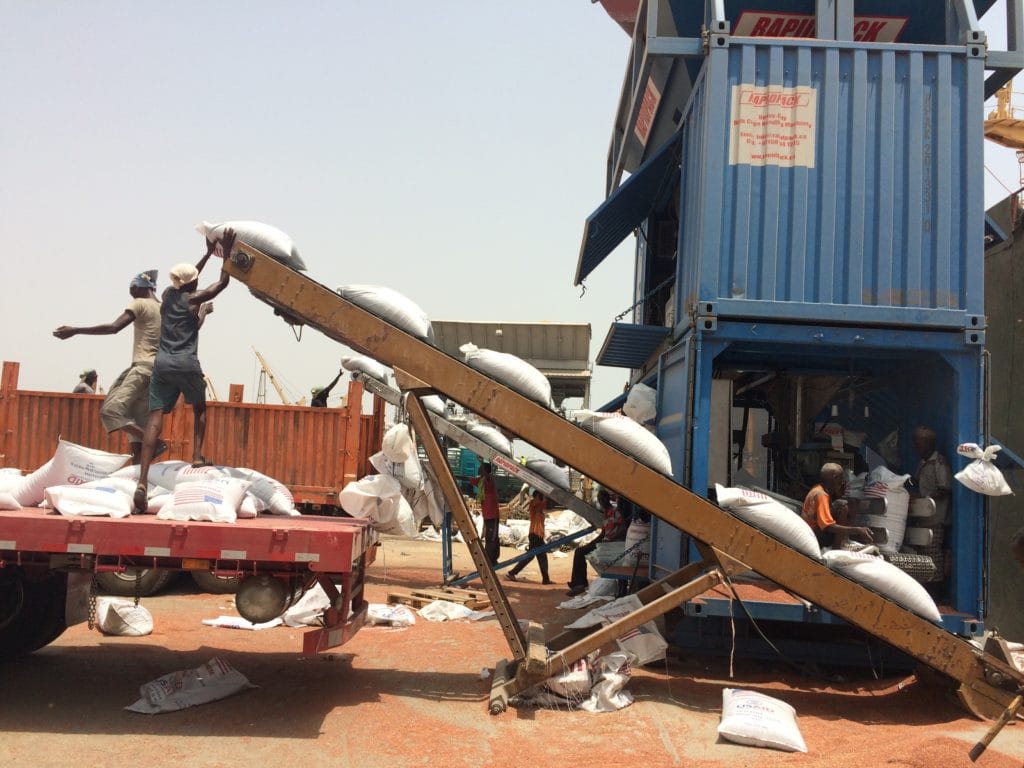
USAID supply planners can get timeliness and cost gains from modernizing how food is bagged in the American food aid supply chain, based on a large pilot procurement. A major development news agency Devex covered this and it was supported by the US Agency for International Development.
Mark Brennan, Prithvi Sundar, Jarrod Goentzel, Dan Frey, and Joanne Mathias. 2019. “One more tool in the food aid toolbox? Experimental evidence from eastern Africa on packaging.” Food Policy. 88, 101746.
Outreach
These are some opinion pieces I’ve written and how to sign up for the Jersey Logistics Report newsletter I send out occasionally.
Interested in signing up for the occasional Jersey Logistics Report? Send me an e-mail at mark.brennan <@> rutgers . edu . Karti Puranam and I send it out out every week or two; it is a no-frills roundup of recent Jersey supply chain and operations news.
New Jersey history and practical fixes can tell us how supply chains might be supported and organized.
Mark Brennan. “Pinelands’ history holds clues to U.S. steelmaking future.” Editorial. The South Jersey Times. [Trenton, NJ] 10 June 2024. Print.
Mark Brennan. “20 years after Hurricane Floyd, what has changed?” Editorial. The Asbury Park Press. [Asbury Park, NJ] 5 December 2019. Print.
Mark Brennan. “Is NJ Still the Garden State? 2017 Census Will Offer an answer.” Editorial. The Star-Ledger. [Newark, NJ] 14 January 2017. Print.
Mark Brennan. “Providing New Jersey Kids with Free Meals an Essential Part of Summer Programs.” Editorial. The Star-Ledger. [Newark, NJ] 27 June 2015. Print.
Similarly, history plus some practical solutions can tell us how key chains in the region and nationally might be organized.
Mark Brennan. As America celebrates Thanksgiving, global hunger takes center stage.” Editorial. The Hill. [Washington DC] 27 November 2025.
Tommy Tobin and Mark Brennan. “Putting Hunger Back on our Policy Menu.” Editorial. The Hill. [Washington DC] 8 January 2020.
Mark Brennan. “Meals Coverage Shouldn’t Lapse in Summer.” Editorial. The Capital Gazette. [Annapolis, MD] 11 June 2016. Print.
